Webhooks
Webhook endpoints subscribe to selected Engage domain event types in one environment. Deliveries are persisted, claimed by workers, retried with backoff, and visible in the console.
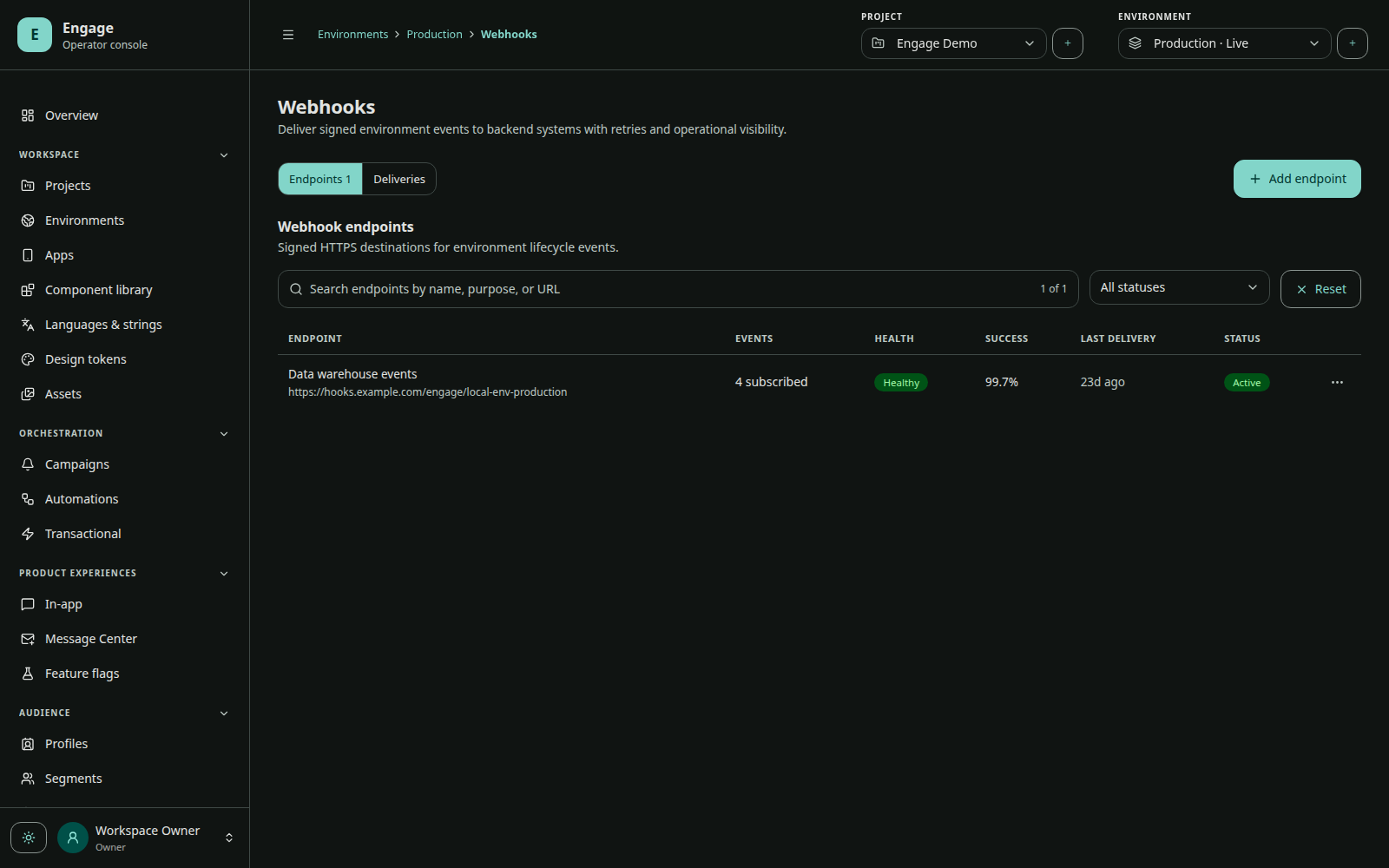
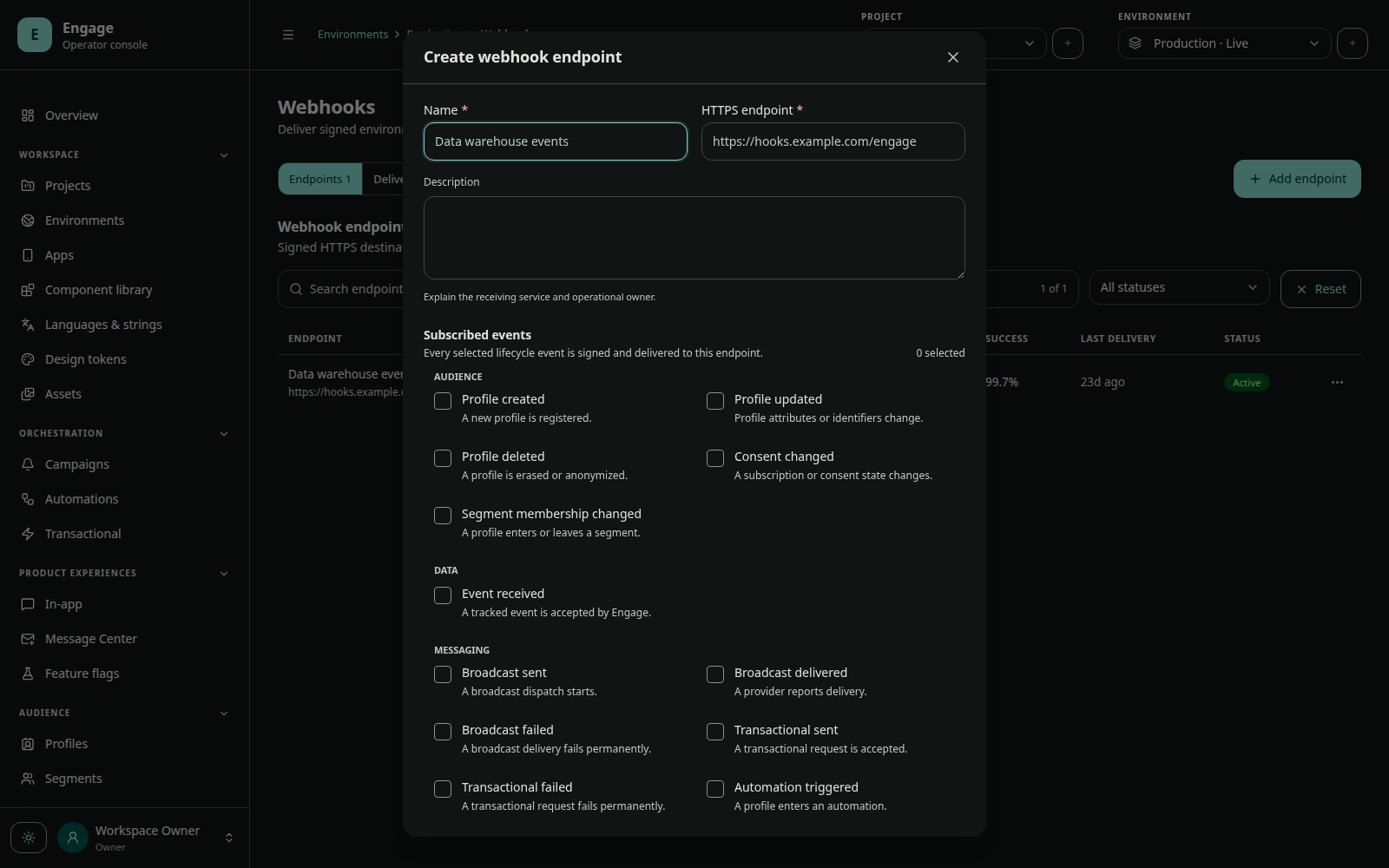
Configure an endpoint
Provide an HTTPS URL, name, event types, optional custom headers, and retry policy:
- maximum attempts;
- initial backoff seconds;
- request timeout seconds.
Endpoint status is active or paused. Health is never delivered, healthy, degraded, or failing based on delivery history and consecutive failures.
Request headers
Content-Type: application/json
X-Engage-Delivery: DELIVERY_ID
X-Engage-Event: EVENT_TYPE
X-Engage-Timestamp: 1787047200
X-Engage-Signature: v1=HEX_HMAC_SHA256
The signing secret begins with engwhsec_ and is sensitive.
Verify the signature
Engage computes HMAC-SHA256 over:
X-Engage-Timestamp + "." + raw_request_bodyUse the exact raw bytes received, compute HMAC with the endpoint signing secret, hex-encode it, and compare to the value after v1= using a constant-time comparison.
Also reject timestamps outside a short tolerance and deduplicate X-Engage-Delivery.
Pseudo-code:
timestamp = header("X-Engage-Timestamp")
expected = hex(hmac_sha256(secret, timestamp + "." + rawBody))
constant_time_equal("v1=" + expected, signatureHeader)
Response and retries
Return any 2xx status only after accepting the event durably. Non-2xx responses, timeouts, and network errors are retried according to endpoint policy. Your handler must be idempotent because a successful processing response can be lost.
Payload envelope
Webhook payloads include type, environment ID, occurrence time, and event-specific data. Use the event ID/delivery header for deduplication and tolerate additive fields.
Delivery operations
The console lists pending, processing, retrying, succeeded, and failed deliveries with attempt count, response code, latency, safe error, and next retry. Filter by endpoint, status, event, related resource, and time range when diagnosing.